
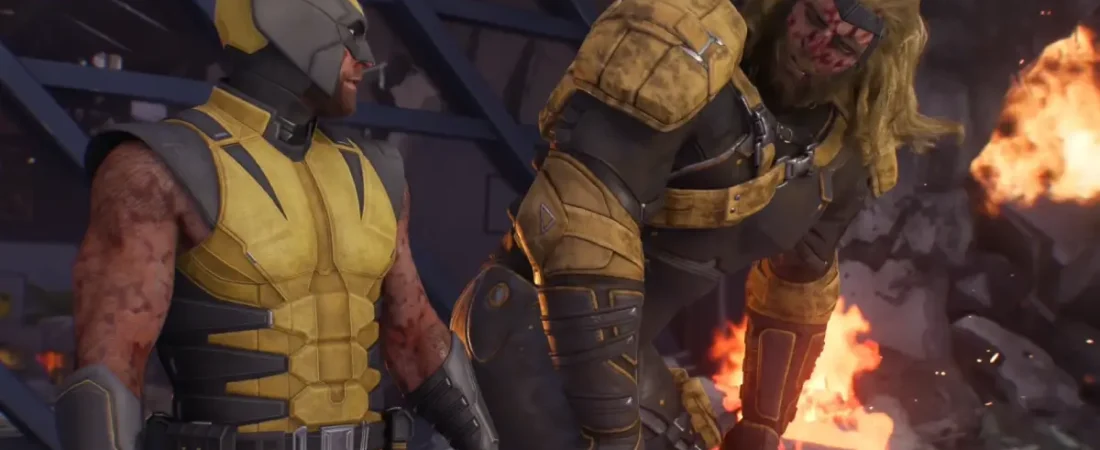
When PlayStation and Insomniac Games officially announced Marvel’s Wolverine, expectations were astronomically high. Following the massive critical and commercial success of the Marvel’s Spider-Man franchise, Logan’s standalone adventure was slated to be PlayStation 5’s next tentpole blockbuster.
PlayStation even went so far as to double down on console exclusivity by keeping major flagship titles off Steam. Many people viewed this strategy as a major vote of confidence, suggesting PlayStation was confident enough in Wolverine and other upcoming PlayStation exclusives as system-sellers to draw players directly to the PS5 platform.

However, early post-launch data paints a concerning picture. While Insomniac Games and Sony have yet to release official global sales figures, a silence that often suggests performance below internal expectations, regional reports provide valuable clues. Behind the initial launch hype lies a dramatic collapse in streaming viewership, cooling search interest, and sluggish sales figures across key international markets.
With a massive $305 million production budget hanging in the balance, the question must be asked: Is Marvel’s Wolverine underperforming right out of the gate?
Streaming & Search Engagement Plummets
One of the most alarming indicators of a game’s ongoing player mindshare is post-launch engagement. According to data tracked via Twitch Tracker, Marvel’s Wolverine experienced a steep 99.73% drop in Twitch viewership within its first two weeks on the market. On its initial release date, the title hit a strong peak of 220,000 concurrent viewers. However, just three days later, peak viewership collapsed to 15,700, signaling a swift decline in streaming interest. Two weeks post-launch, the game is struggling to pull in peak viewer counts between just 500 and 900 viewers.
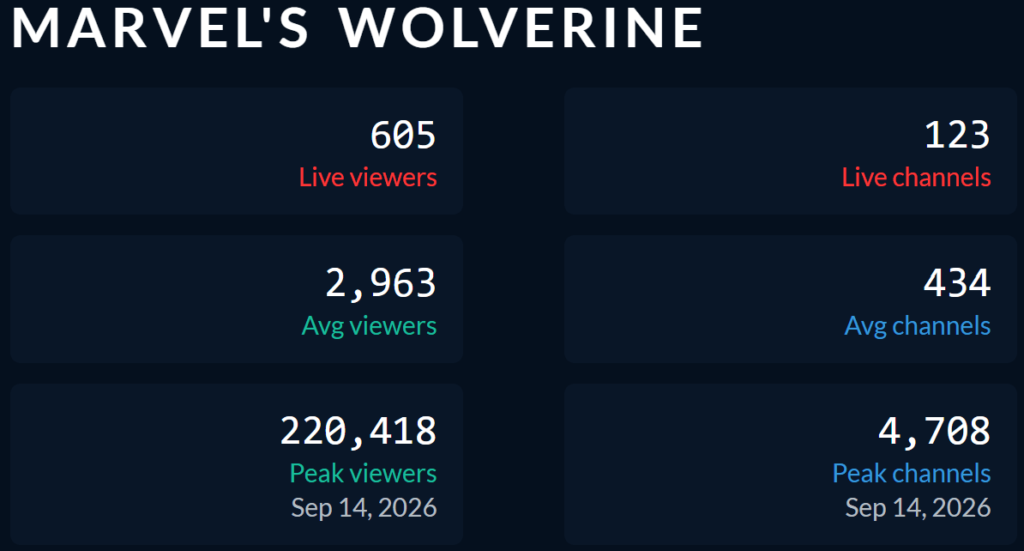
While single-player narrative titles typically suffer faster stream drop-offs than live-service or multiplayer games, a collapse of nearly 100% in two weeks indicates that casual viewer and creator interest dried up almost immediately after initial playthroughs. For context, another single-player title released this month, The Blood of Dawnwalker, debuted with a lower peak of 161,459 viewers on launch day. Yet nearly four weeks later, Dawnwalker continues to pull in steady daily peaks of 5,000 to 8,000 viewers on Twitch, highlighting just how sharp Wolverine’s drop-off is by comparison.
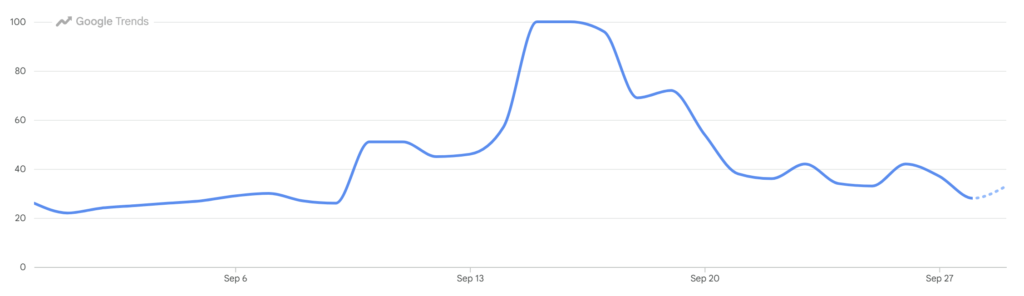
This trend is mirrored in wider mainstream interest. Over the same two-week window, Google Trends data shows search volume for Marvel’s Wolverine dropping by 72%.
Early Regional Sales: Japan and Europe Lag Behind
The engagement drop isn’t just restricted to streaming platforms; early retail sales metrics in key international markets show a noticeable lag compared to Insomniac’s prior releases.
Japan: Barely Breaking 20k Units
According to weekly Japanese retail figures published by Famitsu via Gematsu, Marvel’s Wolverine debuted at #5 on the Japanese charts, moving 20,039 physical units in its opening week. To understand how drastically lower this opening is, consider how Wolverine stacks up against Insomniac’s previous Marvel titles during their respective launch weeks in Japan. While Marvel’s Spider-Man on PS4 debuted with 125,154 physical sales, Marvel’s Spider-Man 2 launched with 77,348 physical sales on PS5, and Marvel’s Spider-Man: Miles Morales pulled in 41,522 physical sales across PS4 and PS5. In comparison, Marvel’s Wolverine moved just 20,039 physical sales, selling less than one-third of the opening-week physical copies achieved by Spider-Man 2 on the exact same console platform.
Spain: Falling Short of Spider-Man 2 Standards
A similar pattern is emerging in Europe. In Spain, traditionally one of PlayStation’s strongest European strongholds, opening launch week sales figures highlight a notable drop in initial buyer enthusiasm. While Marvel’s Spider-Man 2 achieved an estimated 75,000 to 80,000 total units during its launch week (supported by 53,500 physical copies sold), Marvel’s Wolverine managed 51,000 total sales across physical and digital storefronts during its opening week. Although a 51,000-unit opening represents a respectable figure in isolation, it still falls roughly 30% to 35% short of the high bar established by Spider-Man’s return, signaling that Logan’s solo outing is generating noticeably cooler retail momentum across Southern Europe.
Install Base Context and Sales Projections
When evaluating these figures, the expanding PS5 install base makes the comparison even more troubling. At the launch of Marvel’s Wolverine, there were roughly twice as many PS5 consoles in active use compared to when Marvel’s Spider-Man 2 launched in late 2023 when there was an install base of 46.9 million. Yet despite a significantly larger market of console owners, sales momentum appears substantially weaker.
For comparison, Spider-Man 2 surpassed 5 million copies sold globally within its first 11 days. If we assume Wolverine’s sales track at roughly 35% below Spider-Man 2 across all regions based on the sales ratio in Spain, that would put Wolverine at approximately 3.25 million copies sold over a similar timeframe. However, that 35% figure could actually be a charitable estimate. Month-to-month Google search engagement for Spider-Man 2 dropped by only 49% post-launch, whereas Wolverine’s search volume plummeted by 72% in just two weeks. High review scores and sustained engagement gave Spider-Man 2 strong long-tail momentum after week one, whereas Wolverine’s rapid drop in player mindshare suggests it may struggle to maintain long-term sales velocity.
The $305 Million Budget Problem
Lower sales velocity becomes a critical problem when put into the context of modern AAA development budgets. Internal documents leaked during the 2023 Insomniac cyberattack revealed that Marvel’s Wolverine was greenlit with a staggering $305 million production budget. Crucially, that $305 million figure covers only core development costs, it excludes global marketing campaigns, localized public relations, distribution fees, and licensing royalties paid to Marvel/Disney.
When marketing expenses are factored in, total costs for Wolverine could easily reach $400 million or more. At a standard $70 retail price point, where platform holders and publishers retain roughly $45 to $50 per unit after retail and storefront cuts, a game with a $400 million total footprint needs to sell between 7 million to 9 million full-price copies just to break even. If early sales in international markets lag behind Spider-Man 2 and online word-of-mouth fades rapidly, reaching those high sales thresholds becomes a hard climb for Sony.
Is It a True Flop or a Normal Single-Player Arc?
It is worth noting a few key caveats before declaring the title an outright failure. First, physical and regional retail tracking figures do not fully reflect digital purchases via the PlayStation Store, where digital adoption continues to grow year-over-year. Second, character and age rating nuances play a major role, as Wolverine is a darker, mature-rated character compared to the family-friendly, all-ages appeal of Spider-Man—inherently targeting a tighter market segment than a PG-13 web-slinger. Additionally, linear, story-driven games naturally experience sharp drops on streaming platforms once main story beats and endings are spoiled online. Finally, because Sony and Insomniac have yet to release official global sales figures, these estimates remain speculative. It is entirely possible that Sony is simply waiting for its next quarterly earnings call to report official software performance metrics.
However, in an era where AAA game budgets routinely exceed $300 million, these caveats offer little comfort to PlayStation’s bottom line. For a project as immensely expensive as Marvel’s Wolverine, solid sales and niche appeal simply aren’t enough, anything short of a massive, long-tail global blockbuster risks making the game a commercial disappointment.